

In today's highly competitive industrial landscape, 5 axis CNC machining has become a cornerstone technology for companies requiring precision, speed, and flexibility. Unlike traditional 3-axis machining, where tools move in three linear directions (X, Y, and Z), 5 axis CNC allows simultaneous movement along five different axes. This advancement enables complex geometries, faster cycle times, and higher efficiency. Industries such as aerospace, medical devices, automotive, and energy rely heavily on 5 axis machining to achieve tolerances as tight as ±0.005mm.
In this article, we will explore the fundamentals of 5 axis CNC, its advantages, industry applications, cost implications, and frequently asked questions. The content is structured following EEAT principles (Expertise, Experience, Authoritativeness, and Trustworthiness) and includes terminology clarifications, data-backed insights, and industry-focused problem-solving.
What Is 5 Axis CNC Machining?
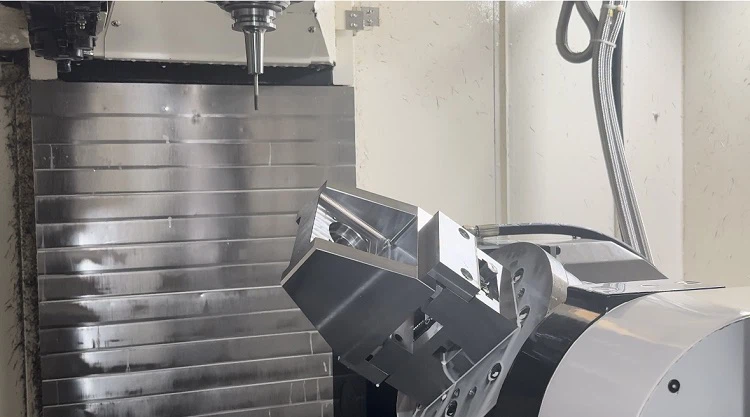
5 axis CNC machining is a subtractive manufacturing process in which a cutting tool or the workpiece moves simultaneously in five axes. These typically include three linear axes (X, Y, Z) and two additional rotary axes (A and B). The result is the ability to produce intricate components without multiple setups.
Simultaneous 5 axis: Both rotational axes move together with the three linear axes, allowing complex freeform surfaces.
3+2 axis (positional 5 axis): The workpiece is rotated to a fixed angle and then machined using standard 3-axis milling.
Reduced setup time
Enhanced accuracy due to fewer repositioning steps
Capability to produce organic shapes and undercuts
Cost savings in long-term production
Terminology Note: Axis refers to the direction of tool movement. In 5 axis CNC, two of these axes are rotational, offering significantly greater design flexibility.
Why Choose 5 Axis CNC Over 3 Axis?
| Feature | 3 Axis CNC | 5 Axis CNC |
|---|---|---|
| Tool Movement | X, Y, Z only | X, Y, Z + 2 rotational axes |
| Complexity of Parts | Simple to medium | Highly complex, organic shapes |
| Setups Required | Multiple | Single setup possible |
| Accuracy | ±0.02mm | ±0.005–0.01mm |
| Applications | Basic machining tasks | Aerospace, medical, automotive |
The ability to reduce multiple setups not only improves accuracy but also minimizes human error. A study published by Modern Machine Shop Journal (2023) showed that companies switching from 3 axis to 5 axis machining reduced their cycle times by 35% on average, leading to a 25% improvement in throughput.

Applications of 5 Axis CNC in Key Industries
Aerospace Engineering
The aerospace sector demands parts with complex aerodynamics and lightweight titanium structures. With 5 axis CNC, manufacturers can machine turbine blades, structural components, and housings in a single setup, ensuring consistent accuracy.
Medical Devices
Implants such as knee replacements, dental crowns, and surgical instruments rely on micron-level precision. 5 axis machining allows the creation of custom curved surfaces, reducing lead times and ensuring patient-specific solutions.
Automotive Industry
Automakers use 5 axis CNC for lightweight aluminum and titanium engine components, gearbox housings, and prototype designs. The technology reduces production costs while ensuring durability in high-performance engines.
Energy Sector
5 axis machining is essential for turbine blades and impellers in the energy sector. These parts require precision cutting at extreme angles, which only 5 axis machines can achieve reliably.
Cost Considerations in 5 Axis CNC
While 5 axis CNC machines typically cost more than 3 axis systems, their long-term ROI is undeniable.
| Factor | Impact on Cost |
|---|---|
| Machine Acquisition | High upfront (USD 150,000–500,000) |
| Programming Complexity | Requires skilled operators |
| Tooling Costs | Higher due to precision cutting tools |
| Production Savings | Fewer setups, reduced scrap, higher output |
A report by Markets and Markets (2024) forecasts the global 5 axis CNC market to grow at 8.4% CAGR, driven by demand in aerospace and medical manufacturing.
Technical Challenges of 5 Axis CNC
Despite its advantages, 5 axis CNC machining comes with challenges:
Programming complexity: CAM software must be optimized for 5 axis paths.
Operator expertise: Skilled machinists are required to minimize tool collisions.
Higher maintenance: More moving parts lead to increased wear.
Terminology Note: CAM (Computer-Aided Manufacturing) refers to software used to generate CNC toolpaths. In 5 axis machining, CAM precision is critical to avoid errors.
Frequently Asked Questions
Q1: Why is 5 axis CNC more expensive than 3 axis?
Answer: The cost is higher due to the complexity of the machine and the skilled labor required. However, reduced setup times, fewer errors, and the ability to create complex geometries result in overall lower production costs.
Q2: Can small businesses benefit from 5 axis CNC?
Answer: Yes. Many small manufacturers use 5 axis CNC prototyping solutions to enter high-value markets such as aerospace and medical devices. Leasing options also make these machines more accessible.
Q3: What materials can be machined with 5 axis CNC?
Answer: A wide range, including aluminum, titanium, stainless steel, and engineering plastics. Each material requires specific tooling and feeds, but 5 axis CNC machining services excel in versatility.
Common Industry Problem & Solution
Problem: A medical equipment manufacturer struggled with inconsistent quality in complex surgical instrument production using 3 axis machining. Multiple setups led to misalignment and high rejection rates.
Solution: By adopting precision 5 axis milling, the company reduced setups to a single operation, achieving ±0.005mm accuracy. Scrap rates fell by 40%, and production capacity increased by 30%, ultimately reducing costs while meeting strict FDA quality standards.
Conclusion
The adoption of 5 axis CNC machining is not just a trend but a necessity in modern manufacturing. From aerospace to medical devices, the technology enables unparalleled precision, reduced lead times, and cost efficiency. With the market expected to grow significantly, companies that embrace 5 axis CNC machining services are positioning themselves for long-term success.
For industries where accuracy is mission-critical, 5 axis CNC stands as the ultimate solution.


